

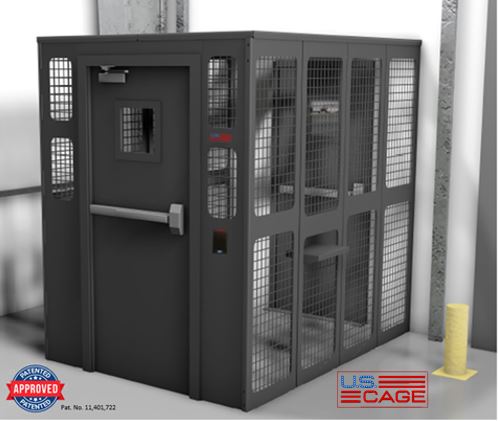
A driver cage is a heavy-duty physical security layer designed to restrict unauthorized access in shipping and receiving environments. In modern warehouse operations, the boundary between the loading dock and the inventory floor represents a significant vulnerability. Without a defined barrier, delivery personnel, third-party contractors, and various visitors gain unrestricted access to high-value assets and hazardous work zones. Implementing a modular driver cage, often referred to as a "mantrap," addresses these risks by creating a controlled transition point that prioritizes both facility security and personnel safety.
Defining the Mantrap for Industrial Environments
The term "mantrap" describes a physical access control system consisting of a small space with two sets of interlocking doors. In a warehouse setting, a driver cage serves this exact purpose. It confines an individual to a secure, mesh-enclosed area immediately upon entering the building. The primary objective is to prevent "tailgating": the practice of an unauthorized person following an authorized individual into a restricted area: and to ensure that visitors remain in a designated zone until they are formally cleared by facility staff.
By utilizing high-strength steel mesh and heavy-duty door hardware, these cages provide a transparent but impenetrable barrier. Warehouse managers maintain full visibility of the visitor while ensuring that the visitor cannot bypass the entrance to wander the facility. This creates an essential air gap between public-facing delivery operations and private inventory management.
Asset Protection and the Philosophy of Keeping Honest People Honest
Shrinkage and internal theft remain primary concerns for distribution and manufacturing facilities. Security operations often focus on sophisticated external threats, yet the majority of inventory loss occurs through "crimes of opportunity." A driver cage acts as a psychological and physical deterrent that effectively removes the opportunity for unauthorized individuals to interact with inventory.
The "keeping honest people honest" philosophy suggests that most individuals will follow facility rules if the boundaries are clear. When a driver enters a facility and finds an open warehouse floor, the lack of boundaries invites casual exploration or accidental proximity to high-value goods. A secure cage provides a clear, professional instruction: this is the limit of your access.

Mitigating Liability and Enhancing Employee Safety
Warehouse floors are high-risk environments characterized by heavy forklift traffic, automated machinery, and overhead hazards. Allowing untrained external personnel to walk freely through these zones creates immense liability for the business. A driver cage eliminates the risk of a delivery driver accidentally wandering into a forklift path or a restricted production zone.
Protecting the workforce is as important as protecting the inventory. By isolating visitors, facility managers reduce the potential for workplace violence, unauthorized contact between external parties and staff, and the spread of contaminants in sensitive environments. The integration of a service window within the cage allows for the exchange of paperwork and digital signatures without the need for the driver to enter the main floor, maintaining a safe social and professional distance.
Small Format vs. Large Format Security Solutions
U.S. CAGE categorizes security enclosures into two distinct tiers to better serve specific facility needs: Small Format and Large Format.
Small Format cages are locally fabricated, boutique-style solutions typically measuring approximately 10' x 10' or smaller. These are engineered specifically for retail enclosures, wireless store inventory, and high-traffic mantrap applications. The hallmark of the Small Format solution is the commercial-grade door and frame, which is built to withstand the rigors of constant daily use while integrating seamlessly with standard low-voltage access control systems.
Large Format cages are designed for scale and utility, often utilized in massive distribution centers and data centers. These systems prioritize high-volume asset protection and are frequently sourced through industry-leading partners like WireCrafters and SpaceGuard. Whether the requirement is a specialized retail vestibule or a sprawling warehouse partition, the focus remains on American-made quality and structural integrity.
Modular Edge vs. Permanent Construction
One of the most significant advantages of a modular driver cage over traditional drywall or masonry construction is the avoidance of bureaucratic red tape. In many jurisdictions, building a permanent wall requires extensive permitting, multiple inspections, and the coordination of various trade contractors (framing, drywall, painting, electrical). This process can take weeks and significantly disrupt operations.
Modular cages are classified as equipment or "furniture" rather than permanent structures. This distinction typically allows for installation without the need for building permits or lengthy inspections. A U.S. CAGE unit is designed for rapid deployment, with most standard configurations being fully installed in hours rather than days. This "Cage vs. Wall" comparison highlights a major cost-saving benefit: the ability to secure a facility immediately without the overhead of traditional construction.
Technical Specifications and Access Control Integration
Security is only as effective as the technology that manages it. A driver cage must be compatible with modern security protocols to be truly effective. U.S. CAGE designs products that are ready for immediate integration with existing electronic access control systems.
- Constructed: High-grade 10-gauge wire mesh or 14-gauge expanded metal for maximum durability
- Dimensions: Standard 6’ x 6’ x 8’ configurations or custom-sized Small Format enclosures
- Modular: Bolt-together panel design for fast assembly and future expansion
- Compatible: Pre-prepped for magnetic locks, electric strikes, keypad readers, and video intercoms
- Hardware: Heavy-duty ASSA ABLOY doors with tempered glass and push-bar egress for life-safety compliance
Integrating these cages with a 6×8 hinged door inventory cage setup ensures that every entry point is fortified. The use of a commercial-grade door frame is a critical differentiator; it prevents the sagging and misalignment issues common with lightweight wire mesh doors, ensuring the locking mechanism remains secure over thousands of cycles.
American-Made Reliability
U.S. CAGE maintains a steadfast commitment to American manufacturing. Sourcing materials and fabricating locally is not merely a matter of preference; it is a commitment to quality control and supply chain reliability. By keeping production domestic, the company ensures that every weld, panel, and frame meets rigorous industrial standards. This approach avoids the long lead times and inconsistent quality often associated with imported alternatives. In an industry where security cannot be compromised, "American-made" serves as the gold standard for dependability.
Enhancing Professionalism and Operations
Beyond security, a driver cage enhances the overall professionalism of a shipping and receiving department. It provides a dedicated area for drivers to wait, complete paperwork, and interact with staff. When equipped with a built-in shelf and service window, it streamlines the check-in process. This organized approach reduces chaos on the loading dock and allows warehouse personnel to focus on their primary tasks without the distraction of managing visitor movement.
Practical Considerations for Installation
When determining the placement of a driver cage, facility managers should consider the primary flow of traffic. The most effective installations are located directly inside the main personnel door of the loading dock.
- Dimensions should accommodate at least two individuals comfortably
- Ceiling panels should be included to prevent "climb-over" intrusions
- Safety bollards should be positioned around the exterior to protect the cage from forklift impacts
- The cage should be anchored directly into the concrete floor using heavy-duty wedge anchors for maximum stability
For facilities concerned about regulatory compliance, it is important to note that cages can be outfitted with emergency exit hardware, such as panic bars, to ensure that the mantrap does not interfere with fire egress routes. This balance of security and safety is a core component of the U.S. CAGE philosophy.
The Long-Term Value of Physical Access Control
Investing in a driver cage is a proactive measure that pays dividends in reduced theft, improved safety records, and streamlined operations. It is a practical, proven security layer designed to slow down bad actors and eliminate common liabilities. As facilities grow and security threats evolve, the modular nature of these systems allows them to be moved, expanded, or reconfigured, providing a long-term asset that adapts to the business.
For more information on how to secure your facility or to view technical specifications, visit our FAQ page or contact a specialist to discuss a custom configuration. Maintaining a secure perimeter is the first step toward total asset protection.

Summary of Benefits
- Controlled Access: Limits visitors to a designated entry zone
- Safety Compliance: Protects personnel from forklift and industrial hazards
- Theft Prevention: Reduces opportunity for internal and external shrinkage
- Rapid Deployment: Installs in hours without the need for permanent construction permits
- American-Made Quality: Ensures high-strength durability and reliable sourcing
- Technology Ready: Integrates with modern electronic locks and card readers
U.S. CAGE provides the heavy-duty solutions required to protect people and property in high-stakes industrial environments. By choosing a modular mantrap system, facility managers prioritize efficiency, security, and professional operational standards.